Retail Field Notes: China (4)
Hema Fresh (Freshippo): Alibaba’s Bold Bet on Reinventing the Supermarket

Over the past few weeks, I’ve been on a deliberate retail pilgrimage across China - walking through the aisles of Aldi, Costco, Sam’s Club, and now, Hema Fresh.
Each retailer represents a different thesis about how to win in China’s grocery market:
Aldi: disciplined hard discount, deeply localised.
Costco: global consistency, buyer-confidence model.
Sam’s Club: discovery-driven membership retail, tailored for Chinese tastes.
Hema: technology-enabled fresh retail, born inside an e-commerce empire.
If Aldi represents operational discipline, and Sam’s Club represents curated abundance, then Hema represents structural reinvention.
Unlike the others, Hema wasn’t a traditional retailer adapting to China.
It was a technology company entering physical retail from scratch.
1️⃣ Origins: When Alibaba Decided to Enter the Supermarket
Alibaba Group launched Hema Fresh (also known as Freshippo) in 2016 as part of its “New Retail” strategy - a bold attempt to merge online and offline commerce into one integrated system.
Alibaba had already built two dominant e-commerce platforms:
Taobao
Tmall
The online infrastructure was mature. The user data was enormous. But groceries remained underpenetrated online due to logistics, freshness concerns, and consumer trust.
So instead of competing with traditional supermarkets purely online, Alibaba asked a different question:
What if we redesign the supermarket itself, using digital infrastructure as the backbone?
Hema was not an extension of Taobao.
It was a laboratory for the future of grocery retail (at least Alibaba Group positioned Hema as it).
2️⃣ Scale and Footprint: Not Just One Format, But an Ecosystem
Unlike Costco or Aldi, Hema does not operate a single, standardised store format.
It has multiple concepts:
Hema Freshippo (旗舰型主力店)
Hema X Membership Store
Hema NB (Neighbourhood discount format)
Hema Premier
Hema Mini
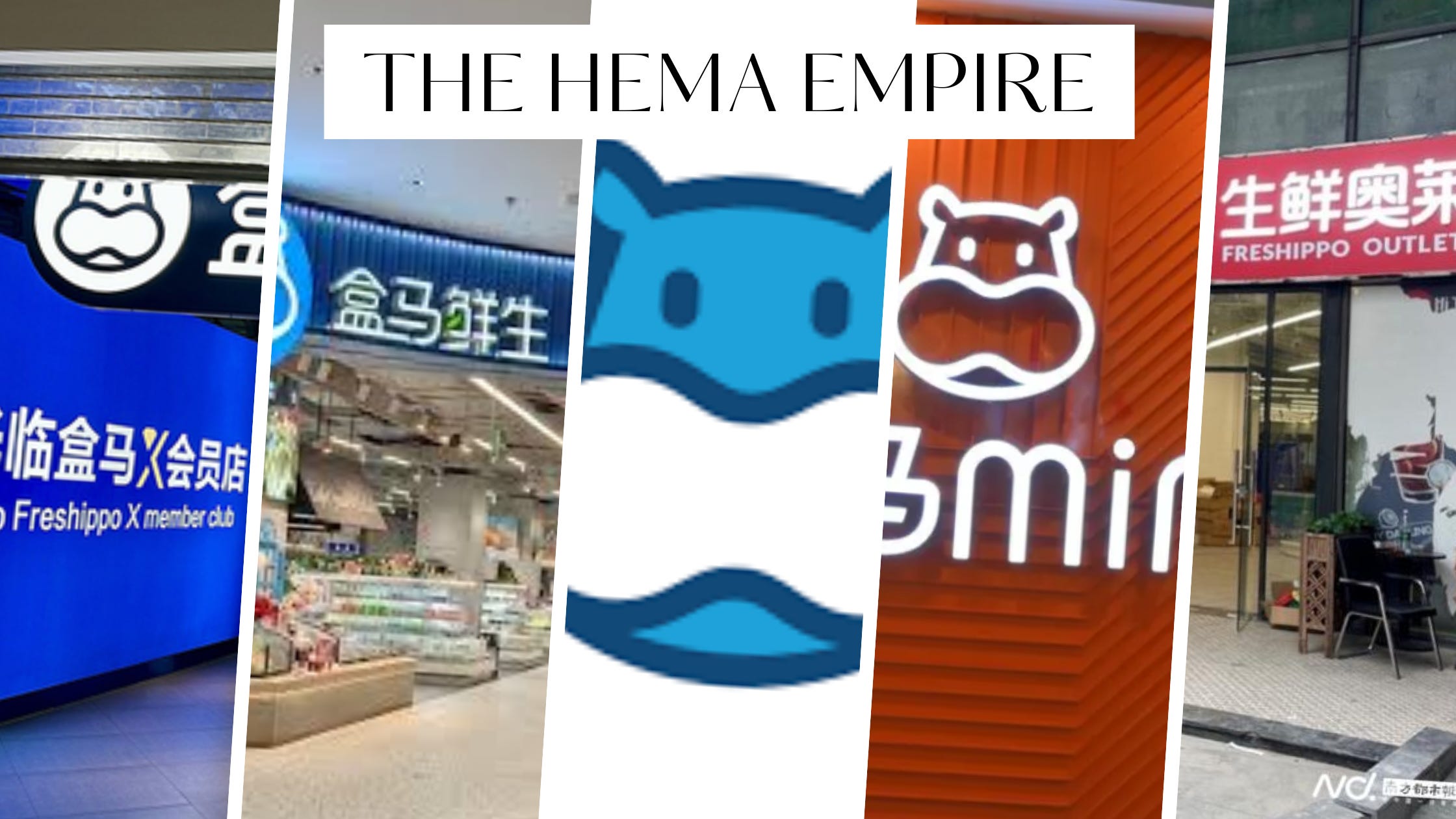
This portfolio approach tells us something important:
Hema is not just a supermarket brand.
It is a retail innovation platform.
Alibaba has invested heavily, not merely opening stores, but experimenting with:
different catchment sizes
different price tiers
different operating cost structures
different levels of service intensity
For a technology company entering retail, this level of capital commitment is striking. It reflects how strategically important grocery retail was to Alibaba’s long-term ecosystem ambitions.
3️⃣ Strategic Positioning: Freshness + Convenience + Digital Integration
Walking into multiple Hema Freshippo stores, what stands out immediately is the emphasis on:
Fresh produce
Refrigerated products
Live seafood
Ready-to-eat meals
Compared to traditional supermarkets, the perimeter dominates the centre store.
This is deliberate.
Chinese consumers prioritise freshness. Wet markets historically dominate fresh food purchasing. Hema’s strategic ambition was to modernise the wet market, not replace the supermarket.
But the true differentiation lies in three layers:
Layer 1: Freshness as Theatre
You can:
Pick live seafood from tanks
Choose fresh meat
Ask the store to cook it for you (for a small markup)
Eat it inside the store
This transforms grocery shopping from transaction to experience.
For working professionals, Hema’s core target, this creates a powerful combination:
Fresh
Immediate
Convenient
Social
Few traditional retailers can replicate this without completely redesigning their stores.
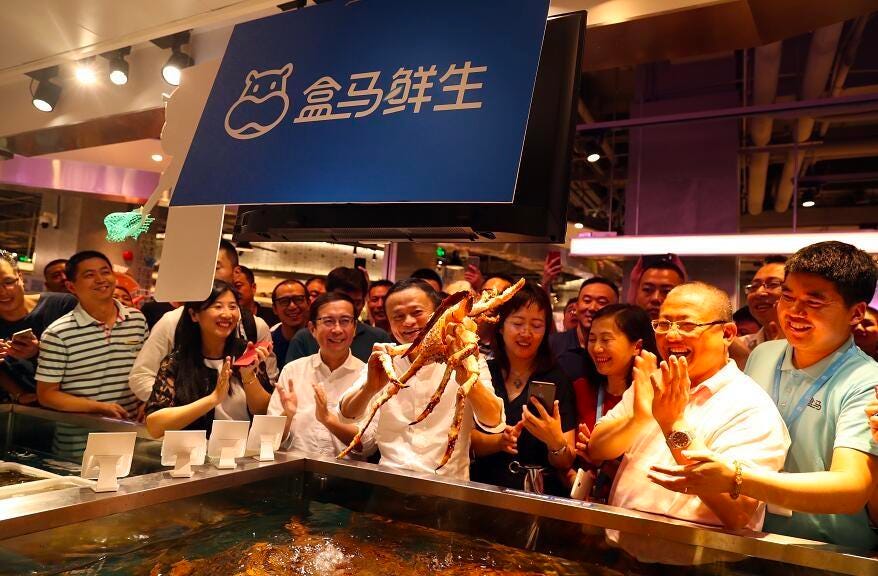
Jack Ma, founder of Alibaba, visiting Hema Fresh store
Layer 2: Digital-First Operations
Hema is not “omnichannel” in the traditional sense.
